
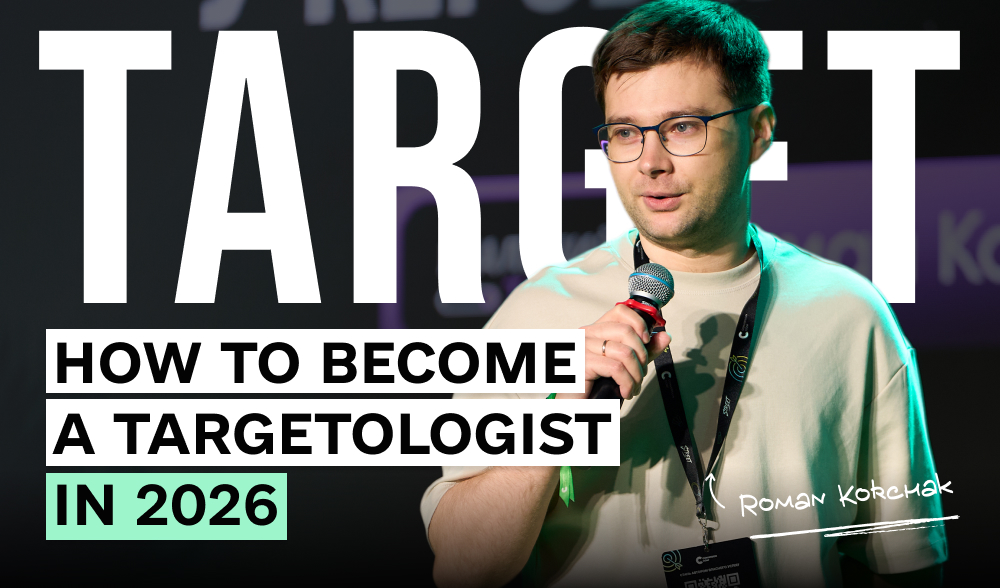
Just a few years ago, targeting was like a game of “find the secret audience”: a little magic with interests, a couple of life hacks from courses, and you’re all set. But today, algorithms are smarter, and the market is tougher. So, how do you target audiences now?
We spoke with Roman Korchak, an expert in traffic and affiliate marketing and the author of the Telegram channel “Real Target,” about what the real path to targeting looks like today, why the market is both oversaturated and hungry, and which skills will truly make a difference in 2026.
What does the path to entering targeting in 2026 look like today?
 Previously, the main value was finding a niche audience: crossing the interests of “business,” “iPhones,” and “travel” to get a cheap click. Platforms were simpler, and the auction wasn’t as overheated. Now, Meta’s algorithms find audiences better than any human can. Manual targeting is practically dead. Although I’ve been saying this my whole life—I work with a broad audience 80% of the time.
Today, a targeting specialist is a strategic marketer. The main task isn’t to select an age or interests, but to create creative content and a funnel so that the algorithm itself latches onto the right audience. Creative content—that is the new targeting. Creative content is king.
Is it true that the market for targeting specialists is already oversaturated? Is there still room for new specialists?
Yes, right now the market is a bit oversaturated, but most of them only know how to drive traffic for the sake of traffic. I personally analyzed a couple of ad accounts, and the main mistake was a lack of advertising budget. In fact, everything was done correctly, but this foundation was flawed and undermined the entire advertising campaign.
There is a huge shortage in the market of competent specialists who understand unit economics, know how to calculate ROI, and can approach a business saying: “I see where you’re losing money in the funnel; here’s how we’ll fix it.” Businesses are willing to pay a lot, but only to those who bring in profit, not just clicks. Every new player in the market, first, motivates others to be better, and second, must have skills that will be useful to the business.
Where should a beginner start: courses, internships, working on a personal project, or immediately looking for clients?
The main thing to understand is that everyone has their own path, but a rolling stone gathers no moss.
Which skills will be more important for a targeting specialist in 2026: technical or strategic?
Strategic skills account for 95% of success. Technical setup now takes 10 minutes and is done almost automatically. If you don’t understand how the funnel works, why people buy, what LTV is, and how to calculate margin—no knowledge of the ad dashboard interface will save you. You need to be a marketer who simply uses Meta as a traffic source.
What knowledge or tools are essential for a targeting specialist today: analytics, AI, creatives, data work?
Google Analytics 4, understanding CAPI, generating ideas and copy (ChatGPT, Claude, Gemini), and creating basic images/videos via AI. This won’t replace you, but it will speed up your work tenfold. Understanding hooks (attention-grabbers), storyboards, the psychology of visuals, and marketing in general should be the foundation at every stage.
How much have changes in privacy and algorithms impacted the work of targeting specialists?
The era of perfectly accurate data ended after iOS 14.5, and by 2026 we’ll be living in a reality where browsers completely block third-party cookies. We’ve lost some transparency. Attribution (understanding which ad generated a sale) has become more complex. But we’ve switched to CAPI. We work with broad audiences. We analyze effectiveness not only based on metrics in the Meta dashboard, but also on the overall impact on the business, calculating business revenue in a holistic manner.
What are the most common mistakes beginners make when launching their first ad campaign?
- Measuring by clicks (CPC) rather than cost per lead (CPA) or ROI.
- Poor creative execution. We launched two images, they didn’t work, and now we’re sitting around waiting for a miracle. You need to test dozens of hypotheses.
- Lack of focus and insufficient understanding of analytics. You launch a campaign, spend $2–3, get no leads, and immediately panic. You have to be patient, because as I always say, aside from dry analytics and marketing, working with Facebook is a creative process—everyone has their own stages and approaches to scaling up.
Where can a beginner find their first clients and build a portfolio today?
Oh, well, I have a whole article on this in my channel. But in short:
When choosing a provider, clients look at your competence. Do you understand their business? Do you ask about average order value and margin, rather than just “what’s the advertising budget”? Any project, even a failed one, can be packaged into a case study. At the start, you need to be transparent and show how you can be useful to the business—and prove it in practice.
Can AI replace targeting specialists?
AI has already replaced narrow targeting. Algorithms optimize campaigns on their own. But AI can’t conduct a briefing with a client, can’t come up with a unique angle to sell a specific product, and can’t convince a business owner to revamp their website because it isn’t converting. The adaptation is simple: delegate routine tasks to AI (writing copy, generating reports, creating basic banners) and focus on strategy and creativity.
Advice for those wanting to start a career as a targeting specialist in 2026
I can’t give just one piece of advice. Here are a few: