
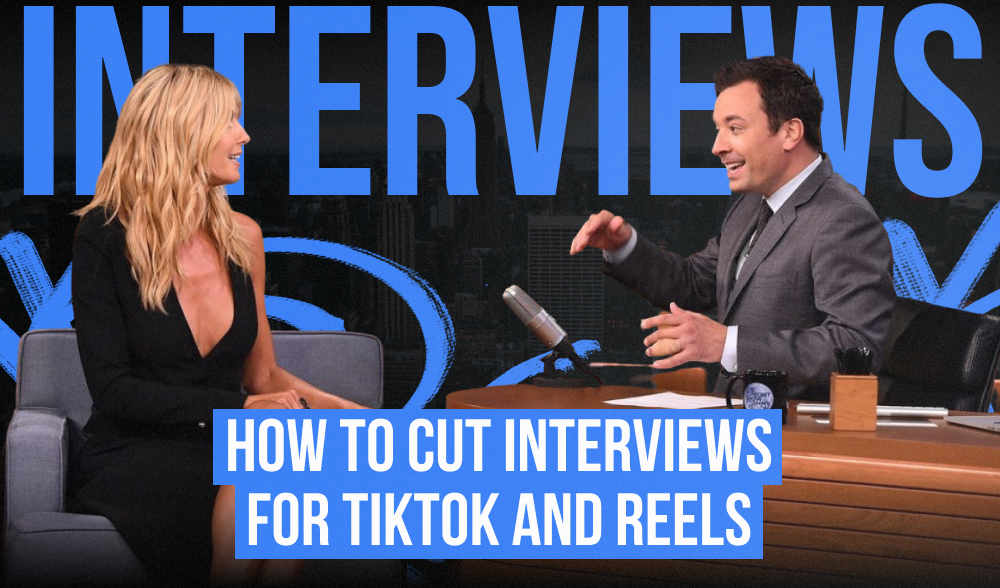
A long interview is not just one video, but 10–30 videos for TikTok, if you edit it correctly. Algorithms don’t need perfect editing, they need meaning and emotion. That’s why interviews work better than scripted formats.
The main mistake is to edit the conversation like a trailer. On TikTok, each clip should stand on its own. In this article, we show you how to turn one conversation into a series of viral Reels and not waste the potential of the content.
Which interviews are good for editing and which are not?
Not every interview works equally well in a short video format. And it’s not about the quality of the footage or the popularity of the speaker. Everything is determined by the structure of thoughts and the way a person speaks.
Answers with a clear focus work best for Reels and TikTok. One thought — one clip. If a phrase can be cut so that it looks complete without any explanations “before” or “after,” then it’s almost a finished video. Moments where emotion comes into play work especially well: a pause before an answer, laughter, an ironic comment, or a bit of self-deprecating humor. Algorithms love liveliness, but people love it even more.
A separate bonus is specificity. Numbers, case studies, admissions of mistakes, unusual decisions. When a speaker says “we failed” or “we lost money because…” it is always stronger than abstract considerations about strategies and markets.
On the other hand, long, cautious reflections do not “cut” well. Answers that start with five introductory sentences and end with nothing concrete are almost impossible to turn into a short format. The same goes for phrases that are “about everything and nothing” — they may sound good in a full interview, but on TikTok, they lose their meaning within the first three seconds.
Here’s a simple test that editors use: Can you cut this piece out of context and it still work? If the answer is yes, you have a clip. If not, it’s a good piece for YouTube, but not for Reels.
The formula for a good clip from an interview
If you look closely at the TikTok, Reels, and YouTube Shorts guides, they’re all about the same thing, just in different words. A successful clip almost always follows a simple formula: Hook → Value → End or Loop. This isn’t a rule from a textbook, but an observation confirmed by thousands of videos in the feed.
The first two seconds are crucial. Hook does not necessarily have to be a shout or a provocation. Often it is a phrase that sounds as if the speaker is about to say something important or uncomfortable. A denial, a doubt, an unexpected turn of thought — anything that makes you not swipe away automatically.
Next comes Value — the reason why the viewer stayed. It can be a short case study, a figure, an explanation, or a clear position. The optimal length is seven to twenty-odd seconds. Longer only if the story keeps the tension. Shorter if the idea is formulated as concisely as possible.
The ending in TikTok is a special thing. There is no need for a beautiful ending here. The platform loves abrupt endings: a phrase that sounds like a conclusion or, conversely, like an unanswered question. It is precisely these endings that often trigger a loop, when the video is automatically replayed without the viewer even realizing it.
As a result, a good clip from an interview does not look edited. It looks as if you accidentally overheard one specific moment from a long conversation and wanted to hear the rest of it.
How to “cut” a moment from an interview correctly?
Editing an interview does not start with a timeline, but with viewing. Experienced editors rarely watch material at normal speed — 1.25 or even 1.5 speed is enough to quickly catch the rhythm of the conversation and not lose the essence. The task of the first viewing is not to edit, but to hear where something changes in the conversation.
The best moments are almost always revealed by intonation. A sharp change in voice, a short pause before answering, laughter, or an ironic break in a phrase are signals that there is a lively thought here. The same applies to marker words: “actually,” “most often,” “the main mistake,” “I realized that…” It is after these words that people usually stop speaking cautiously and start speaking honestly.
When you cut out a fragment, it is important to capture the micro-backstory. Starting a clip in the middle of a sentence is almost always a bad idea. The beginning of the clip does not have to coincide with the grammatical beginning of the phrase, but it must coincide with the beginning of the thought. Sometimes it is half a second of silence or a short breath, and that is what makes the fragment come alive.
A typical mistake is to cut too neatly. Align the pauses, remove “extra” words, make everything perfectly clean. As a result, the clip becomes sterile and loses what made it worth publishing in the first place: human presence. TikTok is more forgiving of imperfection than artificial correctness.
A good clip is a moment that sounds like it wasn’t planned, but that’s exactly why you want to listen to it.
Timings: how many seconds does it work?
There is no “correct” video length on TikTok, the only question is whether the clip maintains its own pace. The algorithm is ready to show both short and longer videos, but it reacts ruthlessly to one thing: empty seconds in which nothing happens.
This is the ideal length for quick insights, apt phrases, meme phrases, and unexpected confessions. Such clips are easy to watch to the end and are often rewatched, even accidentally.
This is the range in which explanations, short case studies, and formulated thoughts work best. This is enough time for a person to say something meaningful and for the viewer not to get bored.
only make sense if the story really grabs the viewer’s attention. This could be a major screw-up, an unexpected twist, or a story in which every second adds to the tension. If the length is simply “because that’s how it turned out,” the video is almost guaranteed to lose its audience.
TikTok isn’t afraid of long videos. It’s afraid of empty time. If there are no seconds in the clip that you want to skip, people will watch it, regardless of the timing.
Vertical format: what’s important not to break
The most common mistake when adapting an interview for TikTok is to perceive vertical as simply cropping a horizontal video. In fact, it is a separate frame logic, with its own rules of attention and perception.
The 9:16 format is basic and unavoidable. But it’s not just about proportions. In a vertical video, the viewer almost immediately looks for the face. If it is lost, shifted, or too small, interest disappears faster than the video starts.
The optimal placement is the face in the center of the frame and the eyes in the upper third of the screen. This is where the focus of attention is concentrated when scrolling. Everything below that works as a background rather than the main element.
The background in a vertical video should be restrained. Excessive space, complex textures, or chaotic details are distracting rather than helpful. The same applies to subtitles: small text in a vertical video is simply unreadable. If words cannot be read at first glance, they are superfluous.
Vertical video requires simplicity. The “put everything in” principle does not work here. Only what supports the voice and emotion of the person in the frame works. Everything else risks ruining the moment.
Tools that really simplify life
No tool can turn a bad clip into a good one. But the right services can significantly reduce the time between “there’s an interview” and “there are finished videos in the feed.” The main thing is not to look for magic, but to choose what eliminates routine.
For quick cutting and basic editing, most teams agree on one thing — CapCut. It allows you to work vertically without unnecessary settings, quickly trim clips, and immediately see how the video will look in TikTok or Reels format. It’s not a professional editing table, but for short videos, it covers 80% of the tasks without overload.
A separate category is AI tools for working with conversations. Transcription and meeting trackers help you find strong moments not by ear, but by text. When you can quickly scan the dialogue and see marker phrases, finding clips becomes much faster. It’s not a replacement for an editor, but it’s a good filter.
Final edits are often more convenient to make directly in the TikTok editor. The platform “understands” its own format better, and simple changes such as trimming the beginning, adjusting the text, and changing the timing are done faster there than in third-party programs.
It is important to remember that tools are just an accelerator. They do not decide what to cut and why this moment is worth paying attention to. But if the logic is already there, the right set of services takes away half the pain and allows you to focus on the main meaning and presentation.
Conclusion
Good Reels and TikTok interviews are not born on the editing table. They appear at the moment when someone in a conversation says something accurate, vivid, and dangerous to indifference.
One conversation can be the source of dozens of clips if you look at it not as a video, but as a set of thoughts, intonations, and reactions. There is no universal formula here, but there is a clear logic: thought is more important than editing, emotion is more important than the perfect picture, and rhythm is more important than duration.
TikTok does not reward diligence. It rewards honesty and accuracy. If a clip works without context, grabs attention from the first seconds, and doesn’t waste the viewer’s time, it will find its audience.
Everything else is a matter of practice. And the more you “cut” interviews with understanding, the less likely it seems that good videos are a matter of luck.