
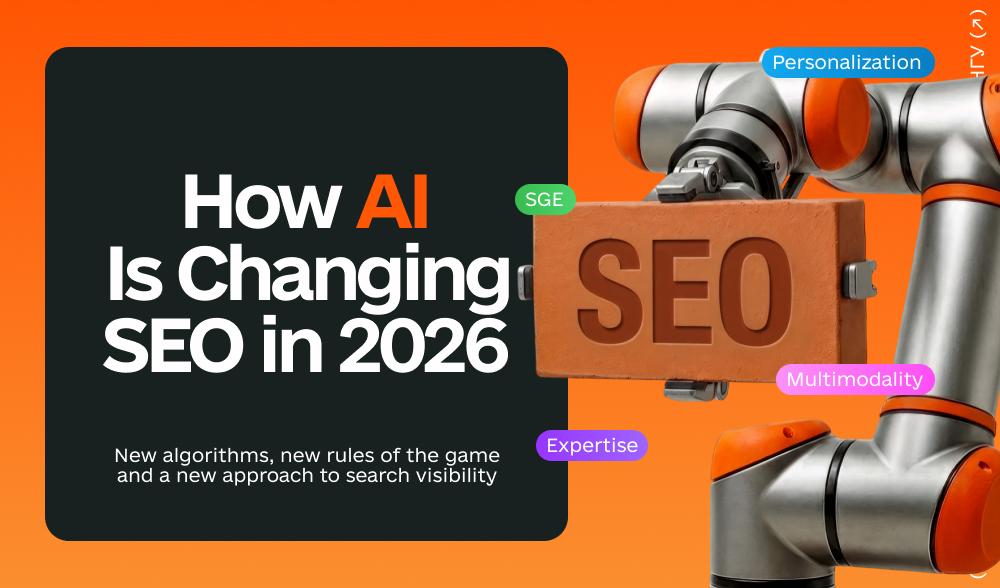
Artificial intelligence is transforming SEO faster than any technology before it. And while it used to be possible to stick with “old-school” methods for a long time, that approach no longer works in 2026.
Agencies that still rely solely on manual processes are starting to fall behind. Those who integrate AI into their work, however, are moving much faster: they scale up, optimize more accurately, and achieve better results.
Search Is No Longer About Keywords
Today, search engines are AI systems that strive to understand content and context. Google is actively moving in this direction:
- Search Generative Experience (SGE)
- AI Overviews
- multimodal search
- content understanding through vectors and semantics
In such conditions, classic SEO is no longer sufficient. You need tools that work with:
- semantic search
- AI-optimized content
- entity-based SEO
- predictive analytics
- automation via LLM
Why doesn’t SEO work without AI tools anymore?
The challenge now is to ensure that the AI system perceives your brand as the best answer to a query. And the numbers confirm this.
According to Gartner:
- 82% of digital agencies increased their investment in AI in 2025
- automation reduced operational time by 32%
- using AI in SEO resulted in a 28–41% increase in organic traffic
What does this mean in practice?
Agencies that use AI:
- work faster
- spend fewer resources
- get more predictable results
They are also adapting to the new reality of search, where the winner isn’t the one who “knows the keywords,” but the one whom AI understands correctly.
Semrush Copilot
Semrush Copilot in 2026 is no longer just an analysis tool. It is a full-fledged system that takes over a significant portion of SEO processes. The service combines several key areas:
- entity analysis (entity SEO)
- competitive analytics
- key query clustering
- ranking forecasting
- AI-powered content optimization
The new version introduces additional features:
- automatic formation of thematic clusters
- real-time AEO optimization
- ranking predictions tailored to the niche
- analysis of competitors’ SGE results
- SEO for multiple languages simultaneously
Why do agencies use it?
The main advantage is automation. Copilot can handle over 70% of routine tasks while maintaining the depth of analysis. This allows teams to spend less time on technical work and more on strategy. Essentially, it’s a tool for those who want to scale SEO without proportionally growing their team.
Ahrefs AI Assistant
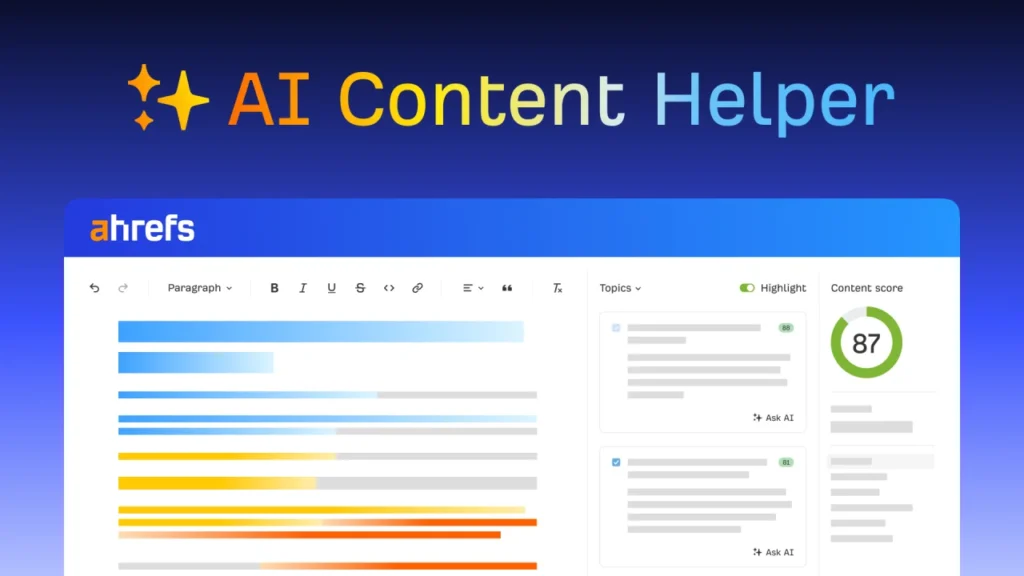
Ahrefs has always been strong in backlinks, but in 2026, it went a step further and added a full-fledged AI layer. Now the tool helps not just analyze links, but build a strategy around them.
What’s changed:
- predicting link-building opportunities
- assessing “gaps” in a site’s authority
- optimizing anchor text via AI
- detecting toxic links
- analyzing competitors’ growth rates
How is this used in practice?
Instead of manually searching for link donors, agencies can build data-driven campaigns:
- where there is potential for acquiring links
- which topics are underdeveloped
- where competitors are already capturing traffic
As a result, link building ceases to be a chaotic process and becomes more predictable.
Surfer SEO AI 3.0
Surfer SEO in 2026 is no longer just about optimizing text for keywords. The tool has adapted to a new reality where context, entities, and alignment with user intent are crucial. The updated version combines LLM models with in-depth content and SERP analysis.
What it can do:
- evaluate text through NLP analysis
- determine search intent and SERP structure
- suggest how to optimize content for AI-driven search results (GEO)
- identify gaps in topics
- generate long-form content with relevance in mind
What makes it powerful?
Surfer is well-suited for teams working with large volumes of content. The tool allows you to systematically cover topics. That is, to create materials that appear to search engines as a complete answer, rather than a separate piece of content.
MarketMuse Alpha
MarketMuse is no longer just about individual texts, but about building a site’s authority. The platform uses machine learning to evaluate:
- depth of topic coverage
- entity coverage
- semantic density of content
- potential for authority growth in the niche
The key update that changes how the tool is used is the Authority Map. This is an AI model that shows which topics and clusters will help boost a brand’s expertise the fastest.
How is it used?
MarketMuse is useful for large projects where it’s important not just to generate content, but to build a long-term strategy. The tool helps answer the following questions:
- which topics are worth developing
- where there are “gaps” in the content
- how to systematically improve E-E-A-T
Jasper SEO Engine
Jasper has long been known as an AI copywriter, but in 2026, it is much more than just a text generator. Its SEO Engine helps build comprehensive content workflows, not just individual articles.
What it offers:
- content adaptation for AEO and new search result formats
- work with the brand’s tone of voice
- integration with Google Search Console and GA4
- automatic updates for old pages
- metadata generation for AI-powered search results
What’s the difference?
Jasper works not as a “text-writing tool,” but as part of a system. It allows you to:
- maintain a consistent style across different projects
- quickly scale content for different brands
- optimize old materials without a complete rewrite
Who is it for?
The tool is especially useful for agencies that:
- manage multiple clients simultaneously
- work with different styles and niches
- build systematic content marketing
NeuralText AI
NeuralText addresses another important task—working with semantics and content planning. Its key strength lies in clustering and forecasting.
What it can do:
- find semantic groups of queries
- identify topics that aren’t yet “overheated.”
- highlight queries with high intent
- suggest what might appear in AI search results
What’s the benefit?
NeuralText helps you stay one step ahead. Instead of diving into already competitive topics, the tool shows:
- where there are open niches
- which topics are just starting to grow
- where you can get traffic faster
Who is it for?
This is a good option for:
- content teams
- SEO specialists
- agencies planning content months in advance
AIclicks
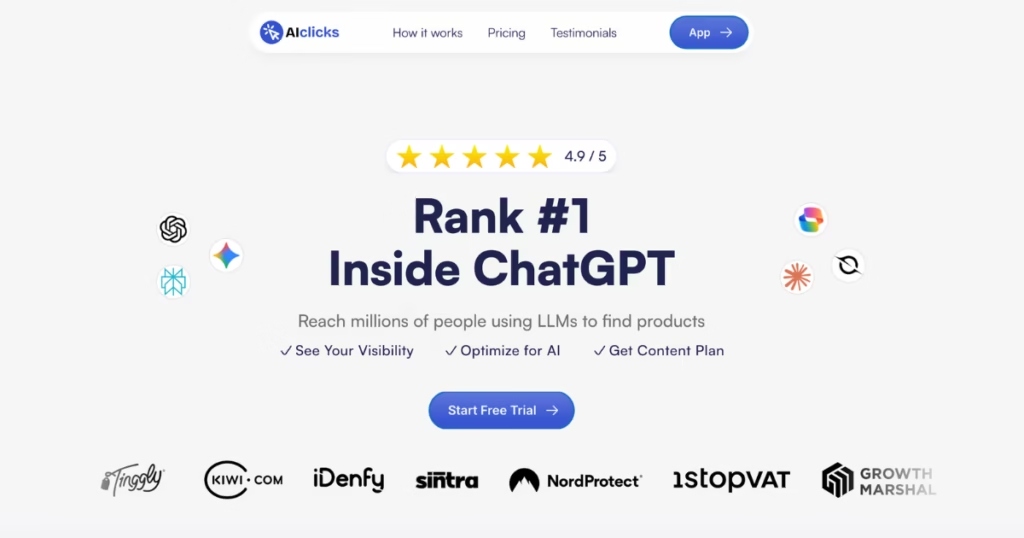
AIclicks is a new kind of tool. It’s not about traditional Google rankings, but about how your brand appears in the world of AI search. Today, users are increasingly looking for answers not through SERPs, but through ChatGPT, Perplexity, or Google AI Overviews. And this raises a new challenge: figuring out if your brand even shows up there.
What AIclicks does:
- tracks how often the brand is mentioned in AI responses
- shows which tools or companies AI actually recommends
- finds the queries users are entering
- highlights where you’re losing out to competitors
- generates ideas for content and actions
What’s its value?
This tool focuses on a new metric—AI visibility. Agencies can do more than just show Google rankings; they can explain to clients:
- whether the brand appears in AI responses
- how its visibility is changing
- what needs to be done to improve it
In essence, this is the next level of reporting and strategy in SEO.
RankIQ Turbo
RankIQ Turbo is a tool that helps you get initial results quickly, especially for new projects. Its logic is built around finding “low-hanging fruit” in search results.
What it analyzes:
- low-competition keywords
- topics that can be quickly “captured.”
- weak spots in SERPs
- content structure via AI
How does it work?
The tool suggests:
- which topics to target first
- how to structure content
- where there’s a chance to rank quickly
This allows you to avoid spending months battling large websites and instead find areas for rapid growth.
Who is it for?
RankIQ Turbo is especially useful for:
- startups
- new websites
- niche projects
- agencies launching SEO “from scratch.”