
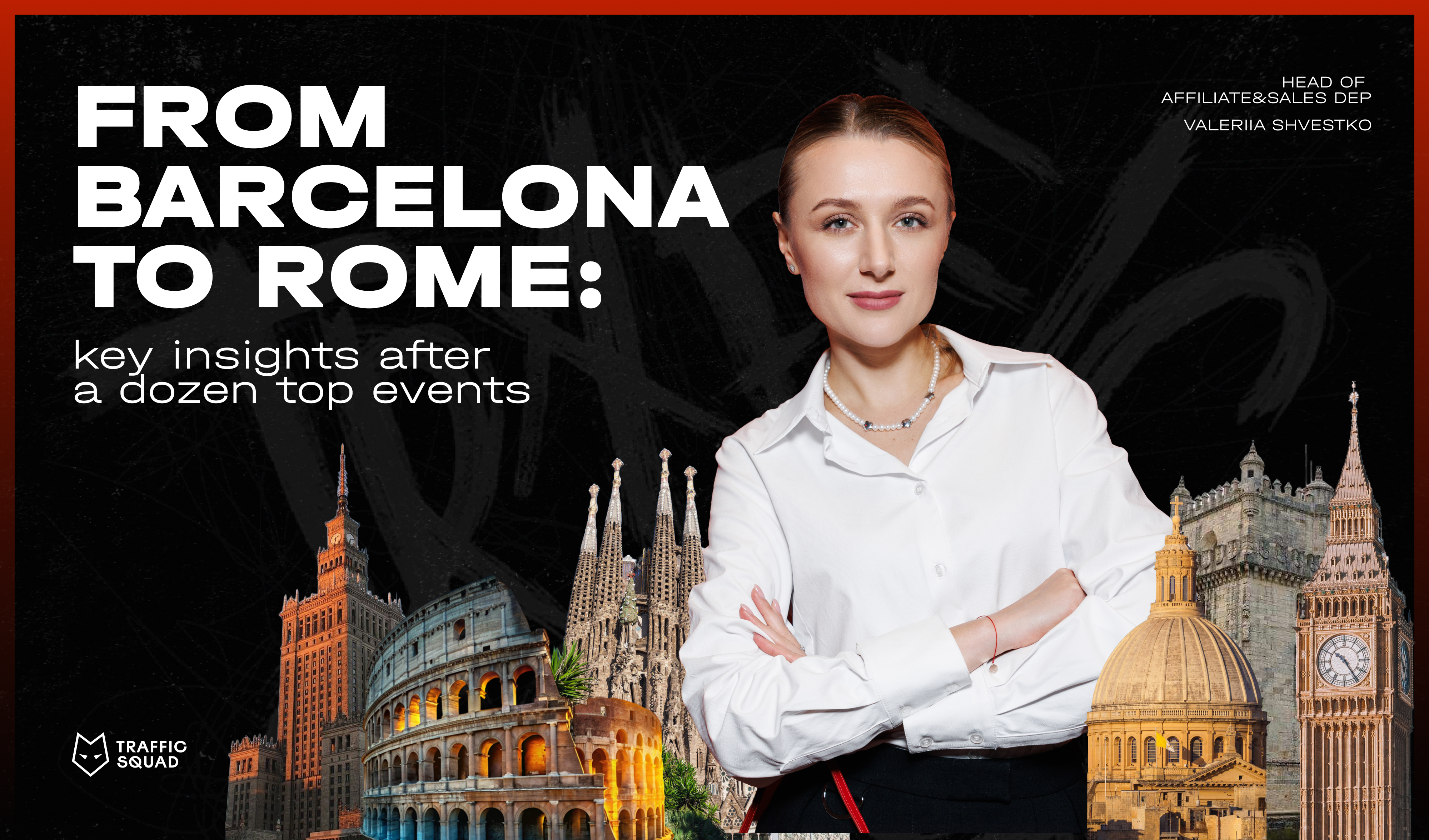
This year has been a busy one — with a dozen international conferences, hundreds of meetings, dozens of potential collaborations, and a couple of thousand handshakes. At Traffic Squad, we never go to events just to hang out — for us, it’s a way to test hypotheses, boost our network, and understand what really works in the market and what just wastes the budget.
🚨 ALARM!
A full day in London with Traffic Squad and EV Media: insights, new connections, partnership talks, and a deep dive into the iGB London atmosphere. Watch the full episode.
In between trips from Barcelona pavilions to Roman rooftops, we asked our Head of Affiliate, Valeria, about her main insights.
Which networking format actually works today? Classic booths, private parties, or small talk?
It’s not the format that matters, but how you use it 🙂
A booth, a party, or small talk — any of these can work if you clearly understand why you’re there. Without a clear goal, even a highly niche event with top-tier people turns into “just another generic meetup.”
At Traffic Squad, every trip is a strategic move. We know in advance who we want to meet, what topics to discuss, and which opportunities to test. All key meetings are scheduled before the conference even starts. At the same time, we always leave room for spontaneity — because sometimes that’s exactly where the best results come from.
My personal TOP 3:
Most of the time, they’re for pre-scheduled meetings and discussions that can be resolved on the spot. Overall, it’s the perfect place to align visions with existing partners.
Private parties are a great space to exchange experience, catch new insights, and discuss real “pain points” — and how different teams solve them.
Small talk is an underrated superpower. You never know who’s standing in front of you. What if that’s the partner you’ll end up making millions with?
How do you prepare for each conference?
We never travel just to “hang out and see what happens.” Everything starts long before boarding the plane. Before the conference, we:
- schedule meetings with partners;
- create a clear checklist for each direction: who to meet, what to discuss, and which questions matter most.
After every conversation, we immediately document agreements — so the most important things don’t get lost in the flow of contacts and small talk.
Affiliate marketing is about partnerships. It’s not just about being present, but about the quality of interaction. Transparency, clarity, and respect for a partner’s time are what build trust. With a structured approach, even a single day at an event can resolve more issues than a week of online conversations.
What are the biggest mistakes teams make at events, and how do you avoid them?
— Events are not a magic pill, even though many people treat them that way. They show up, hang somewhere between the booth and the lounge, and come back with a bunch of contacts… they’ll never message again.
Here are the biggest fail points we’ve seen over the years (and made ourselves) before developing our own effective event formula:
- attending without clear goals — “we’ll figure it out on-site” never works;
- not knowing who will attend, not researching the audience, and not building a list of target contacts;
- not booking meetings in advance and then chasing people last-minute with “do you have a minute?”;
- relying only on a booth and waiting for people to come to you;
- being unprepared for conversations — no pitch, numbers, cases, or clear value proposition;
- collecting contacts for quantity, ending up with 100+ unread chats and zero follow-ups;
- not documenting agreements — discussing things and forgetting them later;
- not planning next steps and leaving everything at “let’s think about it after the conference”;
- wasting energy on appearances — photos, stories, branded hoodies — but no meetings that move the business forward;
- leaving no room for spontaneity, even though it often leads to the most valuable connections;
- sending the wrong people to events — without experience or industry knowledge;
- and the final boss mistake: getting drunk in the first 30 minutes and losing all networking potential before the event even starts.
How do you evaluate an event’s results after returning?
A conference doesn’t start or end on the plane. The first working day after returning is the most important one: sorting chats, responding to requests, and logging contacts. A packed task list is always a good sign after a strong event.
Then comes analysis. We don’t keep things “in our heads” or “for later.” Every meeting is logged with details: who, which vertical, and what was agreed on. After that, we do a full event review:
- how relevant was the audience to our goals?
- how many partners actually moved to testing or agreed on new terms?
- were there insights worth implementing within the team?
For us, success is the conversion of networking into real work. If an event leads to new tests, better offers and conditions, unique deals, new directions, or stronger partnerships — that’s a win.
Not every event delivers the same ROI. Some conferences are about closing deals, others are about understanding trends and gaining access to internal market analytics. What matters is not just attending an event, but coming back with actionable decisions. That’s why results for us aren’t Instagram highlights, but real impact on processes and numbers.
What matters most to you personally at conferences: results, connections, or inspiration?
For me, conferences are a combination of all three. Of course, we go for results — partners and agreements are the foundation. But the real value goes beyond numbers.
These are a few days that remind you why you’re in this industry. Meeting partners, discussing strategies, and seeing how someone solved the same problem in a completely different way — that kind of experience is more motivating than any inspirational post.
And most importantly, conferences don’t work on their own. Preparation, listening skills, clear communication, and follow-up actions do. We don’t just attend events — we integrate them into a system that delivers results, while keeping what truly matters: growth and the drive of building something real.