
Don't miss interesting news
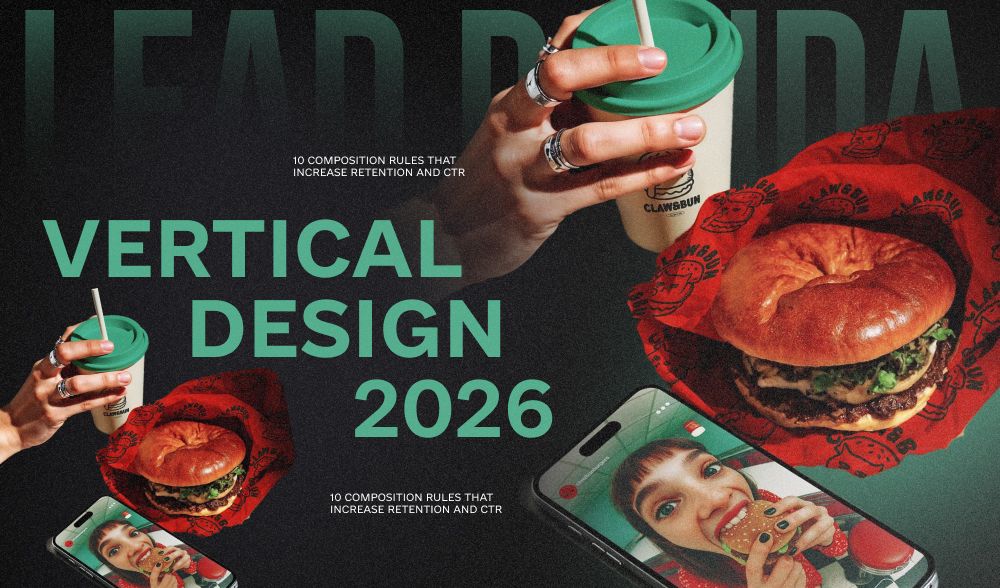
Just a few years ago, vertical video was perceived as something auxiliary. A format “for TikTok,” fast, noisy, seemingly less serious than classic horizontal video. Many brands, media outlets, and marketers treated it with caution: they filmed “just in case,” tested it without a system, or ignored it altogether.
In 2026, this position no longer works.
Vertical video is no longer a trend or an experiment. It has become the basic format for content consumption. Not because of algorithms. Not because of TikTok. But because of how people actually use smartphones, consume information, and make decisions in their feed.
Today, the question is not “should we do vertical,” but how to design it so that it holds attention, doesn’t look random, and gives measurable results. We’re talking about retention, views, clicks, CTR.
The main mistake that many teams still make is treating vertical video as “upside-down horizontal.” Take a 16:9 video, crop it to 9:16, add subtitles, and wait for the result. But vertical works by different rules.
A smartphone is a personal screen. It is always nearby, held in one hand, with content viewed on the go, between tasks, without full focus. In this environment, it is not the one with the “prettier video” who wins, but the one who better fits the user’s behavior.
That is why composition in vertical is not a question of aesthetics. It is a question of readability, rhythm, and the ability of the frame to “hook” in the first few seconds.
Vertical video did not win because it is trendy. It won because that is how people hold their phones.
By default, smartphones are in portrait orientation. Users scroll through their feed with their thumb, watch videos without sound, often on the go or while doing other things. In such conditions, complex compositions, small details, and “slow introductions” simply cannot be read.
User behavior studies show that over 80% of people hold their smartphones vertically when watching videos (ScientiaMobile). This means that vertical is not a platform format, but a basic model of screen usage.
Therefore, all decisions in vertical design start not with the camera or editing, but with the question: how will the user see it in the feed?
There is no time to spare in vertical video. The user does not “turn on the video”; they scroll through the feed. And the decision to watch or not is made in 1-2 seconds. This is where composition becomes critical:
Vertical design is not about being “beautiful” or “trendy.” It’s about whether a person will stay on your video or just scroll on. And therefore, whether they will see the message, reach the CTA, and give you a chance to get a click. Next, we’ll talk about the key rules of vertical composition.
In vertical video, there is no introduction in the classic sense. No one is waiting for you to “get going,” introduce yourself, or explain the context. The user simply scrolls through the feed, and your video either stops this movement or disappears.
That’s why the first 1-2 seconds are critical. At this point, the person has not yet decided to watch; they are only evaluating: is it interesting or not, is it clear or not, is it for me or not. In terms of composition, this means several things:
Creatives that clearly convey the key message in the first few seconds show higher retention and view rates in short-form formats (Meta Creative Best Practices, 2025). This is not about aggressive clickbait, but about clarity.
If the user does not understand what is happening in the first few seconds, they will not wait for explanations.
One of the most common mistakes in vertical video is overloading the frame. When a single video attempts to:
As a result, the viewer doesn’t know where to focus. And in a feed, that means an instant swipe.
Vertical video works better when each frame has one dominant focus — one action, one idea, one visual center.
This is directly related to how attention works. Research on UX and mobile behavior shows that on a small screen, users lose focus more quickly if the visual information is unstructured and competes with itself (Nielsen Norman Group, mobile UX research).
So the rule is simple: if you can’t articulate what’s most important in this frame, the viewer won’t understand it either.
In vertical video, the center of the screen is the most valuable area. That’s where the eye automatically falls, especially in the first few seconds of viewing.
The problem is that many authors and brands continue to think horizontally:
As a result, important elements are covered by buttons, go outside the safe zone, or are simply unreadable.
Platforms clearly show where the “danger zones” are. For example, TikTok and Instagram recommend keeping key elements in the center of the frame to avoid being covered by UI elements (TikTok Creative Center, Meta Creative Guidelines).
In terms of composition, this means:
When the center of the frame is “empty” or occupied by secondary details, the video looks scattered and is less likely to hold the viewer’s attention.
In vertical video, rhythm is just as important as content. Even a strong idea won’t work if it’s presented too slowly or, conversely, chaotically. Users in the feed are not inclined to be patient. They either feel the tempo or move on.
Rhythm in vertical video consists of simple things:
Studies of short-form video user behavior show that videos with a clear internal rhythm hold attention longer, even if they have minimal editing (TikTok Creative Center, 2025). This means that it is not necessary to cut the video every half second. It is more important for the viewer to feel movement and logic.
If the video looks flat and monotonous, the brain quickly loses interest. If it’s too jerky, it becomes overwhelming. The balance between these two states is the working rhythm.
Text is almost always present in vertical videos. The reason is simple. A significant portion of users watch videos without sound, especially on social media feeds. According to Meta, a large proportion of short-form content is consumed in mute mode, especially on mobile devices (Meta Creative Best Practices, 2025).
But text in the frame often becomes a problem. The most common mistakes are:
Text in vertical format should serve a specific function. For example, it should reinforce the key idea, structure the information, or help convey the essence without sound.
The one-screen rule works well. One meaning, one phrase, one focus. If the text takes longer than three seconds to read, it already works against retention.
One of the reasons why vertical videos look messy is the disregard for safe zones. Like, comment, description, and profile buttons take up a significant portion of the screen. If you don’t take this into account at the composition stage, important elements simply disappear.
Platforms directly indicate safe zones for placing content. TikTok and Instagram advise keeping key information in the central vertical area, avoiding the bottom and sides of the frame where the interface is located (TikTok Creative Center, Meta Creative Guidelines).
From a practical point of view, this means:
Safe zones do not limit creativity. They help to make creativity visible in the first place.
Vertical videos are often made as adaptations. First, they are shot horizontally, then they think about how to translate them into 9:16. In 2026, this approach is increasingly yielding poor results.
Vertical design does not start with the frame format, but with the question: how will it look on a small screen from the first second? Mobile-first means simple backgrounds, clear contours of objects, a minimum of small details, and a clear composition that does not require close inspection.
Nielsen Norman Group research in the field of mobile UX shows that users lose attention faster when the interface or content requires additional effort to read. This fully applies to video as well. If a frame needs explanation or adaptation, it already loses to the video.
In vertical video, the CTA cannot exist separately from the composition. If the call to action appears at the end and looks like something extra, most users simply won’t see it.
The reason is simple. A significant portion of viewers do not reach the final seconds. According to HubSpot, it is the first half of short-form videos that garners the majority of views and interactions (HubSpot State of Marketing, 2025).
Therefore, CTAs in vertical videos need to be integrated into the visual logic of the frame, made readable at first glance, reinforced with a gesture, glance, or movement, and repeated in a simplified form if the video is longer than a few seconds.
When the CTA looks organic and doesn’t stick out from the frame, the likelihood of a click increases. When it looks like a banner over the video, it is ignored.
One of the most common mistakes in 2026 is to make a “universal” vertical video and upload it everywhere without changes. The 9:16 format alone does not guarantee results.
Each platform has its own characteristics:
TikTok, Instagram Reels, and YouTube Shorts look similar but behave differently. This is confirmed by the platforms themselves in their creative recommendations (TikTok Creative Center, Meta Creative Guidelines, YouTube Creator Insider).
Therefore, adaptation includes adjusting text placement, changing the rhythm or hook, simplifying or strengthening the CTA, and checking safe zones for a specific interface. Vertical works best when it looks native to the platform, not just cropped correctly.
CTR in vertical videos is often attempted to be increased through copywriting or aggressive hooks. However, composition has an equal impact. If the main object is immediately understandable, the text is easy to read, the frame is not overloaded, and the CTA is easily visible, the user is more likely to take action.
Marketing reports show that creatives adapted to mobile-first and short-form logic demonstrate higher click-through and engagement rates compared to universal formats (HubSpot, Wyzowl, 2025–2026).
CTR does not happen by accident. It is a result of how easy it is for the user to understand what is wanted of them and why it makes sense.
Vertical design in 2026 is not about trends or experiments. It is about clear composition in a feed, quick comprehension, and minimal resistance for the user.
If a frame can be read from the first second, does not require effort, and organically leads to action, then such a frame works to retain viewers and CTR regardless of the platform. That is why vertical video today is not an addition to a strategy, but its foundation.