
In 2026, businesses will need more than just reports; they will need tools that transform a chaotic array of events into concrete actions — today, not “sometime after the quarterly report.”
In this article, we’ll figure out which analytics tools really work in 2026, why regular dashboards aren’t cutting it anymore, and how to pick a solution that fits your tech stack instead of creating even more chaos.
Ingest Labs
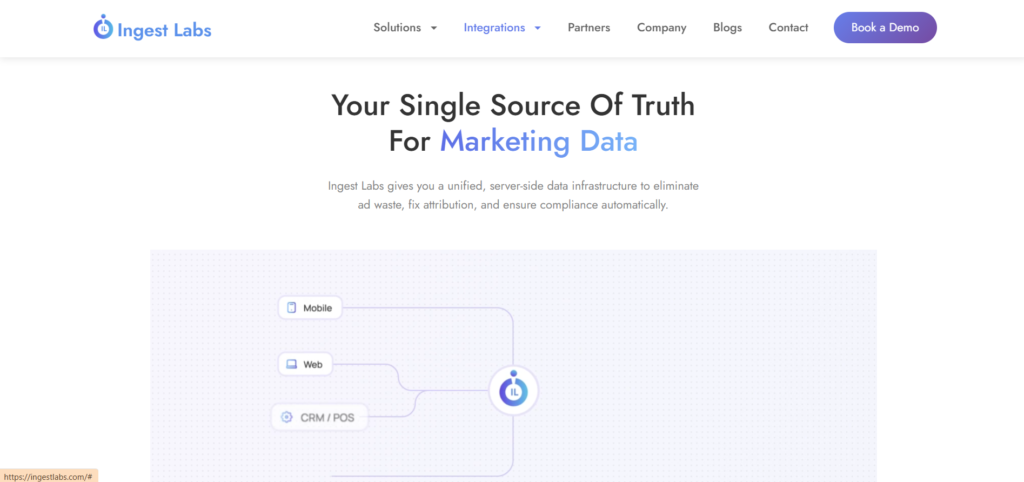
Ingest Labs is a solution for those who live in a cookie-free reality and are tired of losing data due to browser restrictions. The platform specializes in server-side tracking and first-party data infrastructure. In other words, it collects signals that browser pixels simply cannot see.
In 2026, this will no longer be a “plus” but a necessity.
What does Ingest Labs offer?
- Server-side tagging that bypasses ad blockers and browser restrictions
- Proprietary Ingest ID for stable first-party user identification across sessions and devices
- Real-time data streaming to Snowflake, BigQuery, or Segment
- Built-in consent management and GDPR/CCPA compliance
- Unified web and mobile app tracking
Who needs it?
In 2026, iOS restrictions, tracker blocking, and privacy policies have created huge gaps in attribution.
E-commerce brands often miss out on 20-30% of conversions due to measurement gaps. SaaS companies lose the connection between an anonymous website visitor and a CRM contact after registration.
Ingest Labs solves this problem — data is collected at the server level and transferred to where you need it: to a CDP, data warehouse, or analytics system.
Why is this relevant for the Ukrainian market?
Businesses in Ukraine are increasingly scaling abroad, working with different markets, and having to comply with international privacy requirements. Without server-side infrastructure, the question “which channel actually generates revenue?” often remains unanswered. Ingest Labs allows you to measure the entire funnel without losing data at each stage.
Google Analytics 4 (GA4)

In 2023, Google Analytics 4 became the standard for measuring websites and mobile applications and remains the basic tool for most businesses, from small Ukrainian e-commerce to international SaaS projects.
GA4 works on an event model: instead of “sessions,” it records specific user actions — clicks, scrolls, form fills, purchases. The system actively uses machine learning to fill in data gaps and predict behavior.
Key features of GA4
- Event-based tracking model with flexible custom events
- Cross-platform measurement (web + mobile apps)
- Predictive metrics: purchase probability, churn risk
- Free version with fairly generous limits
- Integration with Google Ads, Search Console, and BigQuery
If your marketing is closely tied to Google Ads, the connection with GA4 works as natively as possible.
Who is GA4 suitable for?
Best suited for:
- content sites that track engagement
- small and medium-sized businesses with limited budgets
- campaigns with a strong focus on Google Ads
- teams already working in the Google ecosystem
Less effective for:
- enterprise companies with large amounts of data
- complex multi-channel attribution
- real-time decision making
- in-depth analysis of the entire customer journey
Adobe Analytics

If GA4 is the “basics,” then Adobe Analytics is the pro. It is considered the gold standard for in-depth behavioral analysis and complex segmentation.
This tool is designed for large companies with huge amounts of data and multi-channel funnels: media holdings, omnichannel retail, and international brands with dozens of touchpoints.
Adobe Analytics allows you to not just look at the numbers, but literally “build” your own analytical logic.
What can Adobe Analytics do?
- Real-time segmentation and cohort analysis
- Virtually unlimited number of custom variables and events
- Attribution IQ for multi-touch attribution across channels
- Predictive analytics powered by Adobe Sensei AI
- Deep integration with the Adobe Experience Cloud ecosystem
Who needs it in 2026?
Adobe Analytics is the choice of companies that have:
- A complex customer journey with dozens of touchpoints
- High traffic volumes
- An omnichannel strategy (online + offline)
- A need for accurate multichannel attribution
For example, a retailer with a mobile app, website, physical stores, and active media advertising cannot afford “approximate” analytics.
HubSpot Analytics
HubSpot is not just analytics. It is an ecosystem where marketing, sales, and service are connected into a single logic. And that’s why HubSpot Analytics works especially well for B2B teams with long deal cycles.
What does HubSpot Analytics offer?
- Attribution that connects the first contact with actual revenue
- Campaign analytics: email, social media, advertising, content
- A contact timeline with a complete history of interactions
- Revenue attribution to specific assets and campaigns
- Native integration with HubSpot CRM, Sales Hub, and Service Hub
Essentially, it’s analytics that “sees” not only traffic but also deals.
Who is it suitable for in 2026?
HubSpot is particularly effective for:
- B2B companies with long lead cycles
- SaaS projects
- Inbound teams that work through content and email
- Companies with a clear CRM structure
SEMrush
SEMrush is a tool for those who want to look not only at their own data, but also at the battlefield as a whole. In 2026, competitive analytics has become a necessity rather than a luxury: the market is changing rapidly, and understanding what others are doing often saves months of testing and thousands of dollars in budget.
SEMrush combines SEO, paid traffic analysis, content strategy, and competitor research in one environment. It’s not just a keyword research service — it’s a full-fledged competitive intelligence center.
What can SEMrush do?
- Analyze competitors’ organic and paid strategies
- Track keyword rankings
- Estimate competitors’ traffic
- Approximately estimate advertising budgets on Google and social media
- Analyze backlinks and evaluate content effectiveness
This is especially relevant for Ukrainian businesses that are actively entering global markets: you can quickly see which keywords are driving traffic in the US or EU and what creative content your competitors are using.
How will it be used in 2026?
SEMrush is actively used by:
- SEO teams
- PPC specialists
- digital agencies
- content marketers
With its help, you can:
- find traffic-generating queries
- understand what is driving your competitor’s growth
- “dissect” someone else’s advertising campaign
- find content gaps
In fact, it is a tool that allows you to quickly see where you are losing and why.
Tableau
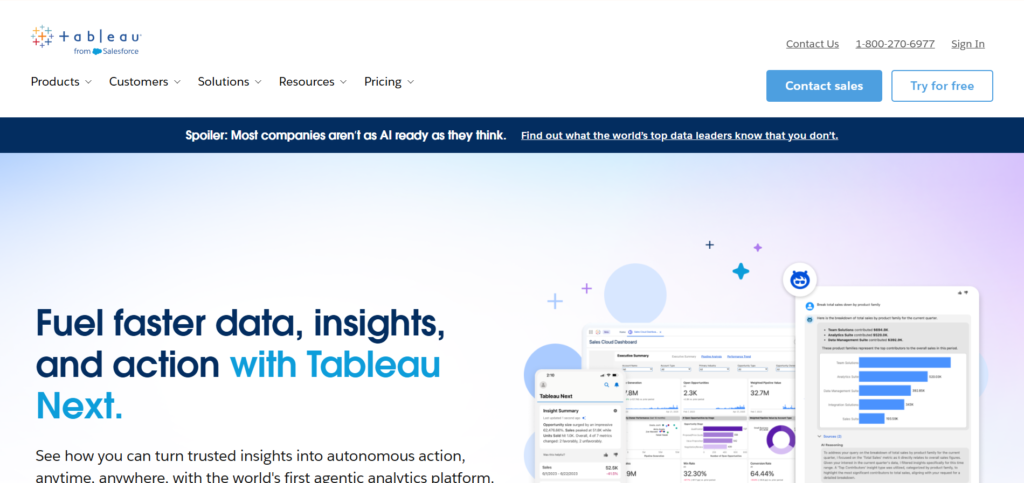
Tableau is not a data collection system, but a tool that turns the chaos of numbers into understandable stories. In 2026, when marketing teams work with dozens of sources at once — from advertising to CRM and CDP — visualization often becomes the difference between “we have data” and “we understand what’s going on.”
Tableau connects to databases, spreadsheets, cloud platforms, and APIs to create interactive dashboards that can be shown not only to analysts but also to C-level executives.
What does Tableau offer?
- Drag-and-drop interface for creating custom visualizations
- Connections to databases, spreadsheets, cloud services, and APIs
- Real-time dashboard updates
- Teamwork and sharing capabilities
- AI prompts that automatically identify trends
For marketing directors, it’s a way to combine data from advertising platforms, CRM, CDP, and GA4 into a single executive dashboard.
Tableau’s strengths
- Works with complex data relationships
- Creates beautiful, publication-quality visualizations
- Connects to almost any source
- Has a strong community and learning resources
How will it be used in 2026?
Tableau helps:
- Bring data from advertising, CRM, and analytics into a single report
- Show the full picture of revenue by channel
- Present the strategy to management
- Identify trends that are difficult to see in raw tables
Conclusion
In 2026, marketing can no longer afford “approximate” analytics. Cookies are gone, attribution has become more complicated, the customer journey is fragmented across dozens of platforms, and budgets are under constant pressure.
Today, the question is no longer whether analytics are needed, but how accurate they are and whether they allow you to act quickly.
- If you need basic web analytics, GA4 is the right choice.
- If you are an enterprise with an omnichannel model, Adobe is a must.
- If you are a B2B company with a long deal cycle, HubSpot will show the connection between marketing and revenue.
- If it is important to understand your competitors, SEMrush will give you a strategic advantage.
- If you need to explain the numbers to management, Tableau will turn chaos into a story.
- And if you are in a cookieless reality and want to close the gaps in attribution, you can’t do without server-side infrastructure.
The main thing is not the tool itself, but the logic of your stack. Analytics should not just show graphs. It should answer three questions:
- What really brings in revenue?
- Where are we losing money?
- What needs to be changed right now?