
Don't miss interesting news
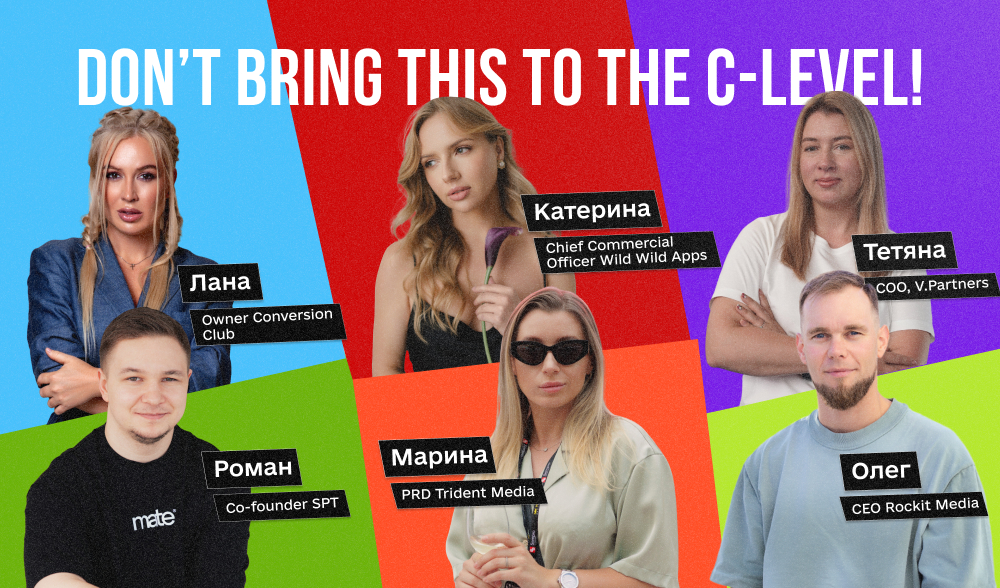
Arbitration has long ceased to be a “toy business” with infantile dreams of “quick wins” and has become a story about a strong team and strategy. Managers no longer look only at yesterday’s profits — they are nervous about anything that destroys consistency, responsibility, and healthy teamwork.
Lana, owner of Conversion Club, is most annoyed by the feeling that everyone wants a good position but does not want to take on the burden of decision-making. People agree to the status of “lead,” “head,” or even “owner,” but they don’t fully understand their job responsibilities and don’t ask, “What exactly am I responsible for and what results should I deliver?”
Another trigger for Lana is the cult of titles. Everyone suddenly became “owners” and “media people,” even though the market can clearly see who really has expertise and who just slapped a flashy label on themselves. As a result, managers have to deal with people who defend their image but not their performance. That’s why a simple rule is so important to Lana: it doesn’t matter what position you hold, the main thing is to remain human and respect your colleagues regardless of their position.

Roman, co-founder of SPT, is sharply triggered by the gap between how people talk about themselves in the media and what is visible in the tracker. On the outside, there are stories about “x3 ROI” and “legendary floods,” but in reality, there are three hryvnia in profit, casts that don’t know how to pull up properly, and a complete lack of understanding of where the result came from.
A separate pain is the first money earned. Instead of investing in training, tools, and system development, some buyers rush to buy a “black BMW” to confirm their status to themselves and those around them. At this point, the manager sees not an ambitious professional, but a person who is playing for show rather than doing business, and understands well where such behavior will lead in the long run.

Roman is equally annoyed when the team works “on a hunch,” without a minimum process architecture. There is no planning, no clear strategy, no automation, no transparent metrics, no normal hierarchy — but there are endless chats, manual actions, and chaotic experiments.
In such an environment, any profit looks like a fluke rather than the result of predictable work. C-level executives are forced not so much to develop the business as to put out fires that arise where a basic system should be working, and this is what creates a feeling of constant “Groundhog Day” for management.

Marina Yushchenko, PRD Trident Media, is frustrated when communication and planning fall apart not because the tasks are objectively difficult, but because of silence and lack of accountability. People see the risks, notice the problems, but remain silent until the last moment, until “blood is spilled,” and only then does panic appear in the chat rooms.
Another trigger for Marina is the substitution of the concept of “community.” Teams want a “warm, active community,” but in practice, this turns into a regular chat room without rules, values, or moderation. Instead of a place of strength, there is endless noise, where important meanings are lost among memes, and managers see wasted resources instead of brand growth.
For Marina, nepotism is a red flag. When decisions are influenced not by your performance skills, but by the status of “this is our friend/relative/old acquaintance,” it always leads to a trail of problems: people without the relevant expertise end up in important roles, and then any screw-ups are covered up.
As a result, managers find themselves caught between two fires: the business loses efficiency, but attempts to “sort out” the situation turn into drama because someone is offended on behalf of “their own.” This kills the culture of honest feedback and makes transparent decisions almost impossible, especially in small teams.

Kateryna, Chief Commercial Officer at Wild Wild Apps, is annoyed every day by the situation where people look for responsibility anywhere except in their own reflection in the mirror. The team may know exactly what needs to be done, but no one steps forward and says, “This is my area, I’ll take care of it.” On paper, everyone is competent, but in practice, everything often gets stuck between chats and tasks.
She is annoyed when, instead of the requested data, she receives “inspiration”: beautiful references and emotions without numbers, depth, or specifics. Similarly, minor “small problems” turn out to be giant black holes because they have long been underestimated and covered up with vague wording.
Kateryna separately notes the culture of myths that are held “just for the sake of it.” The team gets on the hook without a clear goal, without pre-thought questions, without updated data: the camera turns on and off, but the responsibility for the outcome of the meeting definitely turns off.
Reporting also often looks like it was written under torture. Documents are collected at the last minute, without structure, logic, or clear conclusions, which means that C-level executives receive not a tool for decision-making, but a file that still needs to be translated into “human language.” The repetition of this scenario directly undermines trust in the team.
Oleg, CEO of Rockit Media, is most annoyed when the team is afraid to make decisions on their own. People see the task, have enough data, but instead of acting, they bring every step to the manager for approval, turning him into a “universal approval bot.”
Another trigger for Oleg is when people ask questions without even trying to find the answer themselves. In a world where most basic decisions can be tested or pulled from an internal knowledge base, a question like “what should we do here?” without any prior attempt to find out for yourself is a direct sign of immaturity. Added to this is the expectation that “someone will do something for them”: people see a problem, but remain silent and do not offer any solutions, and this, according to Oleg, is more exhausting than any work-related screw-up.

Tetyana, COO of V.Partners, gets nervous when everyone wants traffic to pay off quickly, beautifully, and without drama, but is not ready to include testing, failures, and risk management in their plans. Some players have a myth in their heads about “easy money without stress,” while the reality of arbitration is constant iteration.
Another trigger is process inertia. You ask, “Stop the flood,” but it keeps flowing for another week because no one has taken responsibility for seeing it through to the end. Or, everything is set up, the green light is on, all approvals are in place, and suddenly the traffic disappears into a “black hole” for no apparent reason.
Tetyana also sees a gap between how a brand enters into a partnership with the mantra of “ultra-cool conditions” and the fact that some buyers perceive this as “easy testing without stress,” which inevitably leads to a conflict of expectations.

From the insights of Lana, Roman, Marina, Kateryna, Oleg, and Tetiana, a simple but not always pleasant truth emerges. If you want to work with C-level as partners, rather than “strict adults who are always dissatisfied with something,” it is worth checking yourself daily on several points:
C-level executives don’t get nervous for no reason — behind every emotion is experience in which a lack of responsibility, consistency, and respect for people has already cost companies dearly. And the sooner the market starts to accept this, the less we will have to explain what exactly annoys executives in arbitration, and the more cases there will be where everyone plays the same game fairly.