
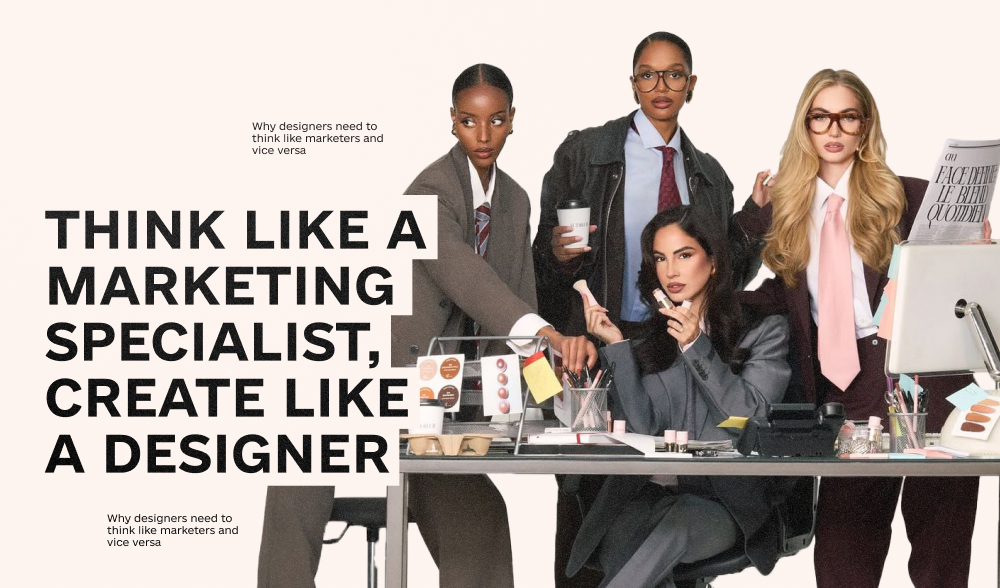
Marketers and designers can work together to create magic that sells if they form a true dream team. Marketers know their audience and its pain points inside and out, while graphic designers translate this knowledge into visuals that grab the audience’s attention at first glance. That’s why today’s brand success depends on the synergy between these two—without mutual understanding, good design won’t sell, and a smart strategy will look too boring if it’s not backed up by visual creativity.
Who is a marketer: strategy above all else
Who is a marketer in today’s reality? It is a strategist who turns business data and audience behavior into sales. A marketer is a specialist who puts themselves in the customer’s shoes: they research what worries them, what makes them happy, where they spend their time online, and how they live. They study competitors, understand buyer psychology, create concepts and messages that resonate, and continuously test.
What else does a marketer do in practice? They analyze who responds to advertising, why they buy (or don’t buy), and which words, triggers, and colors work best. Without this approach, even a skilled web designer will create a website that will go unnoticed.
Designer: first impressions are everything
Graphic designers and web designers are 25% visual psychologists. A designer has exactly 3 seconds to hook the user. During this time, they must convey trust, create emotion in the person, and prompt them to take action. The user/client first sees the colors, fonts, and composition, and then the meaning of the text itself.
Graphic designers often choose blue for financial products (it conveys trust), warm tones for cosmetics (associations with warmth and care), and green for eco-cosmetics, which conveys naturalness. Minimalism is used for technology (conveys professionalism). In general, web designers place key elements in such a way as to clearly emphasize the advantages of the product and automatically draw the eye to the “Buy” button. If a marketer’s strategy is not backed up by good design, there will not be sufficient connection with the audience.
Why designers need to think like marketers
Many designers create works “for themselves” — complex compositions with gradients and effects that look cool in Figma but get lost on the mobile interface. That’s why a marketer is someone who asks: “Who needs this? Where does the button lead? What do we want the user to do?”
Let’s take a landing page for online courses as an example. A web designer can make a stylish gray “Learn More” button, but a marketer will come along and say, “Make a big, noticeable ‘Sign Up Now’ button — size and color are more important than elegance.” This way, they will get a clearly better result — clicks instead of page views.
A professional designer who thinks strategically clarifies the information base about the client before starting work: who is the main client and what concerns them, what specific action we want, studies in detail what visual solutions work for competitors and borrows the best ones for their project. This approach transforms the designer from a simple executor to an expert.
Why marketers need design taste
A marketer who says “make something beautiful” will 100% start an endless cycle of revisions, so don’t do that. What is “beautiful” for a director may be the font from the Nike logo, and for an SMM specialist, it may be Comic Sans with glitter, but that doesn’t mean you should use it thoughtlessly.
A graphic designer is a professional who knows the laws of composition and the psychology of perception and knows how to convey their opinion on this correctly. Imagine a banner for a fitness club where the marketer asks to indicate “First month free,” and the designer adds a before/after photo, a contrasting button, and the right font. You can feel the success of the idea!
That’s why a marketer with a design mindset knows that three fonts on a banner is too much, understands the difference between aesthetics and readability, and gives specific references, without saying “Let’s go with the Apple style, but warmer.”
Common mistakes vs. the right approach
| Marketer’s mistake | Designer’s mistake | The right approach |
| Says “Make it beautiful” without a brief | Creates as if for a portfolio | Follows a clear brief + references, analyzes the market |
| Changes colors on the creative after testing | Ignores the target audience and KPIs | Test first, then edit |
| Tests only on desktop | Inappropriate fonts for business | Mobile priority always, but other formats are also tested |
These mistakes cost weeks of time and large budgets. Proper collaboration saves 60% of the time spent on edits, nerves, and good relationships between colleagues.
Ideal collaboration: from brief to result
Successful teams are all about dialogue. When a marketer gives a clear brief with descriptions: what is the audience, problem, goal, budget. The designer, in turn, offers 2-3 concepts within a clear timeframe. The marketer tests them in advertising or on the website, and the top ones are refined together in brainstorming sessions. Research by The Branding Journal 2026 confirms that brands with adaptive design (marketing + visuals) grow faster.
Checklist: 5 questions for communication
Joint brief from the marketer and designer:
- What is the main problem the product solves for the client?
- Who is the target audience: age, gender, platforms, pain points?
- What action is needed: purchase/sign up/register?
- Campaign budget and deadlines?
- 2-3 references from the marketer
This checklist reduces the time needed for future edits and overall work time.
AI tools (Midjourney, Figma AI) now allow marketers to quickly generate prototypes and ideas. Professional web designers focus on customization for a specific brand and audience, predicting adaptive visual systems where design can change according to the user’s mood and context. Here, too, marketing thinking is essential.
Conclusion: success = marketing × design
A marketer is about strategy, data, and audience research. A graphic designer is about emotions, first impressions, and visual identity. Their collaboration will be a competitive advantage in 2026. A designer without a marketer lacks purpose, and a marketer without a designer lacks soul.
Practical steps to get started that you can implement: first, hold a joint briefing where the marketer provides the target audience and goals, and the designer clarifies the visual constraints. In 2-3 days, the first mockups appear, which are then tested in advertising or on the website. Under these conditions, the best option is scaled, and the team learns from real data. Because brands where the marketer and designer think as one grow faster than their competitors. Learn to think like a colleague on certain issues and you will become indispensable in the market.