
Don't miss interesting news
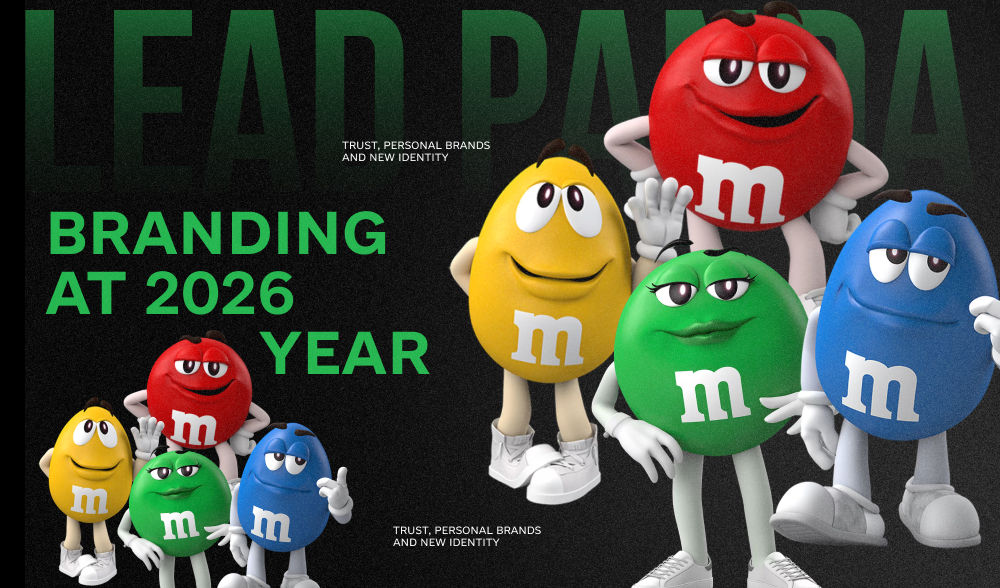
Every year, branding promises a “new era.” This year, three major shifts are clearly emerging.
First, agentic AI is changing the very logic of branding and marketing: from strategy to daily decisions. Second, personal branding is no longer a “performance” and is increasingly becoming an asset: with control, its own audience, and real relationships, rather than reach for the sake of reach.
And third, visual identity is evolving from a set of static elements into flexible systems that work with feelings, experience, and context, not just form.
So, here are the key branding trends that will define brand strategy, personal brand development, and identity design in 2026.
In 2026, simply “being visible” is no longer enough. AI agents have fully entered the game and are increasingly influencing people’s choices. Not as a search tool, but as an intermediary that recommends, filters, and even chooses for the user. This shift is noted in most global trend reports today, including Interbrand’s research.
When decisions are increasingly made not by humans directly, but by algorithms, the rules of the game change dramatically for brands. Trust becomes the main currency. Not loudness, not the number of advertising touches, and not even top positions in search results.
A high Google ranking or social media presence is no longer enough. In 2026, brands will be forced to rethink the very logic of their online presence. The winners will be those whom AI agents perceive as reliable, understandable, and consistent, and people perceive as brands they really want to trust and support in the long term, rather than just in specific situations.
Here are the key trends shaping strategic branding in 2026.
AI agents are becoming the new “gatekeepers” of the customer journey. They decide which brands will be seen, which will be recommended, and which will ultimately end up in the shopping cart. This is forcing companies to completely rethink their digital presence. Classic SEO is no longer enough. It is important that brand information is clear, consistent, and recognizable across the entire digital environment — from websites and marketplaces to social networks and third-party platforms.
Brands are gradually moving away from chasing short-term demand and instant leads. Authority is coming to the fore. A clear strategy, deep content, a unique position, partnerships, and consistent brand signals all work to build long-term trust. The goal is no longer to “be everywhere,” but to be relevant and consistent where it really matters.
AI is becoming widespread and commonplace, but at the same time, there is a growing demand for what feels alive and real. Part of the audience enthusiastically embraces new technologies, while another part openly resists them. This was clearly demonstrated by the wave of criticism surrounding AI-generated Christmas campaigns by major brands, including Coca-Cola. The key challenge for companies is finding a balance: how to use technology without losing their human face.
The personal branding of founders, CEOs, and key company representatives is becoming critically important. When AI blurs the line between real and artificial, it is especially important for people to see who is behind the brand. Teams are coming out of the shadows, with more behind-the-scenes content, honest stories, and “imperfect” moments. This is what builds trust and a sense of familiarity.
Instead of dry targeting by age or gender, brands are increasingly working with emotional resonance. The question is changing: not “who are we selling to,” but “what should the person feel.” Brands are starting to project mood, atmosphere, and experience, not just messages. That’s why the value of physical contact is growing again. Offline spaces are turning into places to experience the brand, with branded cafes, events, and formats featuring music, sound, and taste. Brands are reconnecting with people through the five senses, not just through a screen.
The importance of personal branding continues to grow, but its form is changing significantly.
Social networks are no longer seen as a stable foundation. Instagram and LinkedIn algorithms seem unpredictable, and the feeling of control over one’s own presence seems illusory. People are tired of spending hours on “catchy” content that simply disappears from the feed in a few hours without any effect.
In 2026, the strongest personal brands no longer try to be everywhere. On the contrary, they deliberately reduce the number of platforms and move to spaces they can control themselves: their own websites, newsletters, and closed communities. This explains the popularity of formats such as Substack as a hybrid of media, website, and community in one place.
At the same time, the widespread use of AI content is bringing back the value of the personal voice. People respond not to “correct wording” but to thoughts that only a specific person can express. Sincerity, doubts, unfinished ideas, and internal hesitations are perceived as more relatable than perfectly polished narratives. What was once considered a weakness now works in favor of trust.
Another important change is that the audience is no longer passive. Personal brands are increasingly inviting people to co-create: to write texts together, launch projects, and shape ideas. Followers are gradually becoming co-creators, and communities are becoming more important than abstract “reach.”
In 2026, personal branding is no longer so much about influence as it is about connection.
Strong personal brands are built on personal experience and a unique perspective. Generalized messages quickly lose their weight. Instead, a unique perspective and a willingness to speak from a position of lived experience, rather than borrowed knowledge, are valued.
Against the backdrop of AI-generated content, perfection seems cold and distant. Brands that allow themselves to make mistakes, express doubts, and share “raw” thoughts seem more alive and trustworthy. Imperfection becomes part of expertise.
Reach and engagement on traditional social networks are declining. More and more authors are questioning the advisability of investing all their resources in platforms where they have no control. This is stimulating a shift to formats with their own audience — newsletters, websites, chat communities.
In 2026, the number of collaborative formats will increase: co-authored materials, joint courses, interview series. Instead of fighting for attention, growth will come through collaboration.
Subscribers are increasingly less likely to be perceived as mere viewers. They are involved in generating ideas, shaping content, and developing projects. This changes the very nature of personal branding from a “one-way” communication to a dialogue.
Personal websites, email databases, and newsletters are becoming key assets. Control over audience relationships reduces dependence on algorithms and external decisions, and this is what authors and experts increasingly value in 2026.
Visual identities in 2026 are becoming more vivid and flexible. Design is no longer just about images; it is moving into the realm of sensations. Texture, depth, sound, and movement are becoming increasingly important. Brands want to be not just seen, but felt.
Logos and identity systems are gradually moving away from rigid fixation. Instead of static forms, there are adaptive, moving solutions that change depending on the context, screen, or environment. The same is happening with colors: brands are abandoning strict palettes in favor of overall mood and emotional tone. Motion design and sound are becoming an integral part of identity, adding life and engagement.
At the same time, designers are increasingly abandoning sterile “perfection.” In 2026, we see a return of grain, textures, scans, collages, and rough layouts. Zine culture, scrapbooking, and DIY aesthetics are back in the spotlight. Visual language is becoming more handcrafted, uneven, and human.
Another notable trend is an interest in the boundary between the real and the unreal. Surreal images, distorted shapes, and playful absurdity are popping up everywhere. AI gives designers the tools to go beyond logic—towards emotions, associations, and curiosity.
Below are the key graphic trends shaping design in 2026.
Logos and identities are created to change depending on the platform, format, and context. Forms become softer, more mobile, sometimes “fluid.” They look alive and flexible, rather than fixed once and for all.
Instead of rigidly defined colors, brands work with variable color themes. It is important not to repeat a specific shade, but to convey a recognizable mood and feeling. This makes the identity more dynamic and natural.
Movement, sound, and interaction are becoming increasingly important. Design actively uses glass, translucent, wax, and hyper-realistic textures that create depth and the effect of physical presence. In 2026, it is not only important how the design looks, but also how it “feels.”
Xerox aesthetics, grain, crumpled paper, dust, and repeated scans all create a sense of analog and live work. Polished gloss gives way to personal, sometimes rough visual gestures. Imperfection becomes not a mistake, but a stylistic choice.
Typography is becoming less strict and more playful. Designers are mixing different font styles instead of following rigid type systems. In certain contexts, expressiveness and character are more important than perfect readability.
AI opens up space for visual experiments that seem strange, funny, or unusual. Reality is combined with elements of dreams and fantasy. Such images catch the eye, are memorable, and give a sense of escape from everyday life.
As a continuation of the 2025 trends, design is moving towards bold typography and cinematic compositions. Even mundane scenes are presented as emotional, beautiful stories with mood, drama, and a sense of the moment.