
Don't miss interesting news
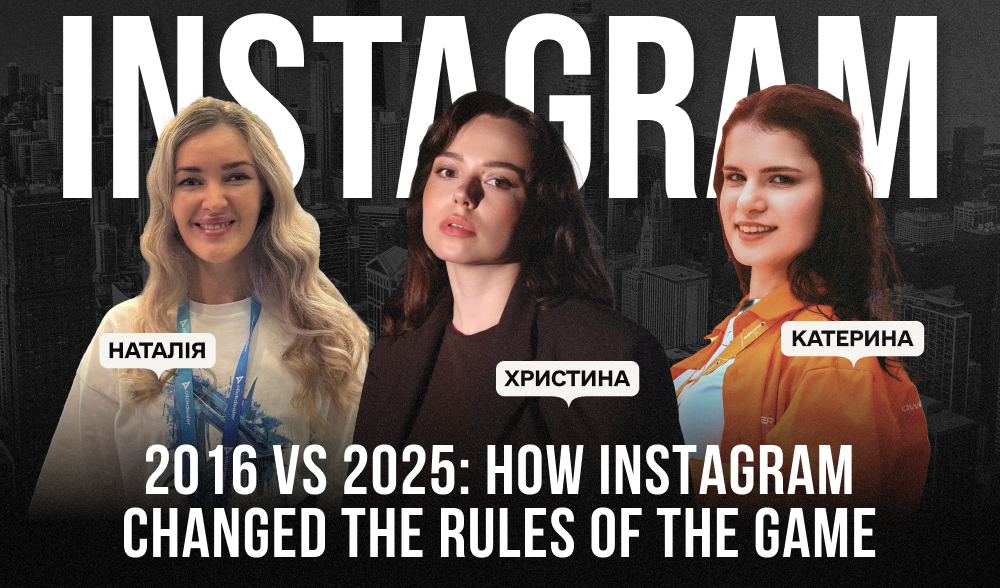
Ten years ago, Instagram was a place where we kept memories: morning coffee, vacation, new sneakers, a cat in the sun. The tape resembled a film — a little filtered, but sincere. Likes were collected more easily, algorithms did not dictate the rules of the game, and the word “SMM strategy” sounded more like something from the future.
What exactly has changed in these ten years? Why has organic become unstable, polished visuals become suspicious, and video is the main driver of growth? And does modern Instagram have its own “new 2016” — a window of opportunity for those who know how to play by the new rules?
We talked to practitioners about how the platform, the work of specialists, and user behavior have transformed. And why today social networks are no longer about posts, but about analytics, hypotheses, and the fight for seconds of attention.
Previously, Instagram was more like a catalog or a camera roll: a place to capture moments and lifestyle. Today, it is a full-fledged communication channel, a platform for sales, entertainment, and brand development.
In many niches, the reality is quite harsh: if you are not on Instagram, you are nobody to your audience.
Ten years ago, the goal of social networks was precisely communication, which fully justifies the very name social media. Content was created for people, not for algorithms.
Then static content dominated, today – videos and animations. 10 years ago, it was much easier to gain views, likes, and subscribers: less competition, simpler algorithms, and more organic. That’s when stories appeared as a light and lively format.
There was more lightness and a sense of authenticity in social networks. Now the user lives in conditions of constant content overload, where attention has become the most valuable resource.
Firstly, social networks were simply not so saturated back then. Now it’s difficult to find a brand without its own account. For example, we recently launched a new brand, and even choosing a name became a challenge, because most of the options were already taken.
Secondly, the very logic of content consumption has changed. Previously, if you followed an account, you really saw its posts in your feed. Today, it’s very easy to get “lost” due to algorithms and competition for attention. I even recently opened my old Instagram and ClickDealer page — these photo collages look very nostalgic.
And most importantly, the role of the platform has transformed. Ten years ago, Instagram was more of a social network: to show yourself, share moments, save memories. Now it’s a full-fledged media platform with algorithms, a fight for reach, constant updates of formats, and a complex content distribution system.
In 2016, Instagram was just gaining momentum – we posted everything in a row, just to share with friends. Back then, no one thought about sales, expertise, or strategies. Now it is a professional platform: people come here not just to see how their friends are doing, but to have fun, find something useful,l or buy something, and the platform has been completely rebuilt for this.
Instagram stopped showing content to all subscribers automatically. The algorithm began to decide who and what to show, focusing on the likelihood of interaction with a particular post.
As a result, organic reach became lower and unstable: subscription no longer guarantees visibility, and content competes with the entire user’s feed, and not just with other brands.
This directly changed the daily work of an SMM specialist. If previously regularity was enough, now you need to try much harder to make the content catch your eye from the first seconds, keep your attention, and cause a reaction. Organic reach is no longer the basis. Now it is the result of quality, formаt and audience engagement.
As far as we’ve noticed, the main change is the complete unpredictability of the result. Previously, you were sure that your subscribers would see your content. If people are subscribed, they see posts in the feed. Now, it’s almost impossible to predict the “breakthrough” in recommendations: algorithms decide more than regularity.
Once upon a time, a page held the bar of success due to stability: you regularly publish, gain views and likes, and grow. Today, this is not enough. You need to constantly test new formats, change the presentation, experiment with videos, carousels, reels, and hooks in the first seconds.
That is, if before systematicity worked, now it’s flexibility and readiness for continuous experiments.
Previously, we posted content and all subscribers saw it, but with the advent of the algorithmic feed, everything changed: now organic is work: you need to think about how to hook, how to keep attention, how to get interaction.
Visuals are still an important component of content, but they are no longer the main thing. Today, meaning, honesty, and recognition are valued, not a perfect picture for the sake of a picture.
Advertising by bloggers has greatly influenced the decline in trust in polished content: when today someone enthusiastically tells what a cool Huawei Ultra 100500 Pro Max he bought, and in the next story he appears again with an iPhone. This has taught the audience not to trust the perfect image.
Users no longer want to see the “successful success” that Instagram has been saturated with for some time. This has ceased to motivate. People buy from people and trust people — real ones. Most people do not have a polished picture of life, and they simply do not recognize themselves in such content, which is why it repels and looks artificial.
Additionally, the popularization of AI content has influenced this: today, seeing a perfect visual, the user increasingly suspects that it could be AI. That is why the raw format breaks through banner blindness amidst the general idealism.
Now, behind-the-scenes formats are especially valued: how a product is created, how a team works, live processes, unsuccessful shots — everything that returns a sense of reality and humanity.
When I look at those filters from 2016 now, everything is “licked”: porcelain faces, a blurred background, a perfect picture. Back then, it seemed like a quality standard.
But due to the oversaturation with gloss, advertising with an “ideal life” and, additionally, content generated by AI, the situation has changed dramatically. Now, live, real content without excessive filters and retouching is much more valued. Stupidity has become the new currency of trust.
For brands, this means another important change: the audience wants to see not only the product, but also the people behind it. The “face of the brand” is becoming critically important. Today, it is not enough to have a recognizable logo; you need to show who is behind the company, what its values are and a living story. This is what builds trust and long-term loyalty.
A slick feed with perfect colors was the standard a few years ago; now it looks artificial. The audience is tired of the perfection in social networks and has stopped trusting it, and raw video, live emotions, and imperfect production give a sense of authenticity, and this is what now holds attention and inspires trust.
Reels can truly be considered one of the most radical changes in the history of Instagram, because they changed not the format, but the very logic of the platform. Instagram ceased to be a social network about photos and followers and began to work as an entertainment platform with recommended content, where video became the main tool for growth.
In 2016, such a format simply could not exist. Back then, Instagram was still a photo-oriented product, and users didn’t consume short vertical videos for hours. There was no mass culture of short-form videos that would form the habit of watching recommended content without being tied to subscriptions.
In addition, in 2016, Instagram was already going through other fundamental changes — the launch of Stories and the transition from a chronological feed to an algorithmic one.
In 2016, can you imagine how long it took to bring a video to the “ideal” with filters? And that’s with the Edge mobile internet)) Back then, the process of creating content itself required much more effort and patience.
And in general, Instagram was then mainly a platform for photos — coffee, food, travel, aesthetic moments. There was almost no video, and if there was, it was rather an exception.
It was the transition to video formats that became the turning point. With the advent of Stories and later Reels, the platform effectively changed the rules of the game: algorithms began to operate differently, competition for attention intensified, and the pace of content consumption skyrocketed. It was no longer just an evolution of the format — it was a complete transformation of the ecosystem.
In 2016, such a format could not exist; there was no habit of consuming content at such a pace, there was no habit of sticking around for hours, there was no TikTok as a trigger for change, which completely changed the logic of platforms; people were simply not ready for it.
Previously, users opened the feed to see how their friends live, watch a few bloggers, and like cats. Instagram was about social context and curiosity about the lives of others.
Today, the feed is opened for a different purpose: to buy something, find something useful, learn something, or just get distracted. Content has become more recommendatory, and Instagram is a place where the user is not looking for specific people, but for ideas, solutions, or emotions.
As I said, then Instagram was a real social network. It was a place to communicate with friends, a photo album of life. And now people do everything there — show themselves, shop, look for recommendations, learn, and even read the news!
In 2016, Instagram was opened to see what was new from friends – it was a feed of people you know. Today, Instagram is open not to watch people, but to get an emotion: to get stuck, have fun, learn something or buy something; it doesn’t matter to the user whether they are subscribed to the author or not; it must be interesting.
This happened at a time when organic reach ceased to be predictable. After the transition from a chronological feed to an algorithmic one, it became obvious: even good content no longer guarantees visibility.
At first, brands still tried to “pull out” organic, but with the growth of competition and oversaturation of the feed, advertising gradually became a way to maintain presence, and not just scale the result.
This was finally consolidated when Instagram began to actively embed advertising into its own formats, in particular in Stories. From that moment on, a strategy without paid support became unstable for most brands.
Today, Instagram advertising is not a separate tool, but part of a strategy: organic, creative and paid work together. Without it, a brand simply loses in the fight for attention.
When algorithms changed, when competition became very intense and when Instagram became one of the most powerful tools for brand recognition among a young target audience. Then everything changed!
Somewhere in 2018–2019, when organic reach began to decline rapidly, it became clear that Instagram is a business platform. Now, without a target, a brand simply does not exist for a wide audience. Advertising has become a basic part of the strategy.
This path has undoubtedly become shorter. If earlier Instagram was more of a place of inspiration, after which people went to Google or searched for the brand’s website, today, part of this path takes place directly within the platform.
You can still talk about organic sales, but mainly in the format of UGC content — when users themselves talk about the product. At the same time, this is no longer the “pure” organic: much of such content today looks like native or hidden advertising.
Organic traffic also comes through Reels and even through Google search, where Instagram posts are now displayed. That is, even those who are not subscribed to the account can find the content.
At the same time, Instagram has shortened the path to purchase: shops, product tags, and the ability to buy something without leaving the application have appeared. But these features are not available to everyone and not in all countries.
As a result, organic sales exist today, but most often as part of a mixed model: organic introduces and builds trust, and the final purchase decision is often reinforced by other formats or advertising.
The path has become significantly longer! Now the conversion does not happen “at first glance”. The user has become much more picky. He needs several interactions with the brand and studying reviews to gain trust and then make a purchase. Again, this is all due to the oversaturation of competition, identical products and the activation of scammers
Previously, you could sell anything with the help of one post, but now the user sees the content several times, watches stories, saves, gets used to the brand and only then buys. Organic sales still exist, but this is the result of systematic work and a much longer process.
Some of the skills that worked in 2016 have actually lost their relevance today. Relying only on regular posting, the “right” time of publications and a beautiful feed often yielded results back then. Now this is not enough. The perception of social networks as a simple channel for publishing content without a deep understanding of the platform and the audience has also stopped working.
Instead, other things have become much more important. SMM today is about video and the ability to hook from the first seconds, about analytics and understanding why content works or not, and about working with the audience: comments, reactions, UGC, live interaction, and not just publications according to a content plan.
The role of tools has also changed. An SMM person must navigate algorithms, the logic of paid promotion, format testing and use automation and AI as part of daily work, not as something additional.
In short, before, an SMM specialist was more about design and regularity, and today it is about thinking, adaptation, analysis and working with people, not just with content.
Skills that are not needed: following up, focusing on likes, and the perfect look.
Skills that are needed: analytics, understanding algorithms, the audience and what they are looking for.
Mass following, chess aesthetics of posts, a bunch of hashtags are all a thing of the past, now SMM is about being a screenwriter, editor, and a bit of a psychologist, you need to be able to hook in the first 3 seconds and understand why a person did not scroll.
Why is modern SMM less about “posts” and more about analytics, hypotheses and working with audience behavior?
Previously, SMM was really more about publishing content “by feel”. The more posts, the better. There was less uniqueness, less competition, and the mere presence in the feed already gave results.
Over time, more analytics tools appeared directly within social networks, and this greatly changed the approach. We began to see not only likes, but also how people behave with content: what they watch, what they save, and at what stage they lose interest. This made SMM more conscious and manageable.
At the same time, the understanding came that content is created not for algorithms, but for people. Because of this, communities, closed clubs, and formats for involving the audience in creating a product began to actively develop. Brands began to ask users’ opinions more often and really take it into account, rather than simply “broadcasting messages.”
SMM ceased to be something secondary and became a full-fledged profession — with goals, responsibility, and impact on business. Work with hypotheses has appeared: trial Reels, testing formats, pitches, messages — not “on intuition”, but with analysis of results.
The understanding of why brands need social networks has also changed significantly. This is no longer a story about “make us a lot of sales here and now”. Social networks work on recognition, trust, interaction and only in combination — on sales.
As a result, today it is not enough to simply post. Modern SMM is about analytics, hypotheses, testing and working with audience behavior, and not about the number of posts in the feed.
I will tell you this, sometimes no one needs your super creative ideas, but you need a cold mind to create something from the available keys, current trends and formats that will suit your brand in terms of tone of voice and will be interesting to your audience.
Today’s post by itself no longer decides anything. The same content can either fly or not get any impressions at all. Therefore, SMM today is a constant testing: the first seconds, presentation, format, and meaning. We look at the numbers, draw conclusions, change the approach, and only then scale. Content is not a result, but a tool for testing hypotheses.
Modern Instagram does have its own “new 2016”, but it looks different. Organic growth is still possible; it just stopped being massive and random.
Today, organics most often come through Reels and search — content is found not only by subscribers, but also by a new audience, including through Google.
The best chances are those who do not follow trends but create their own presentation and stand out. The algorithm is more likely to pick up content with a clear idea that causes a reaction, rather than repeating what has already been seen hundreds of times.
Working with the audience also plays an important role: communities, interaction, UGC, live discussions. These are the signals that show the platform that the content has value and deserves wider coverage.
Today, the “new 2016” on Instagram is possible for those who consciously work with the platform, test formats, and are not afraid to be noticeable.
It is difficult to give a direct recipe, but I think that these are exactly the experts in a narrow, clear niche who do high-quality storytelling for brands.
Now it’s a trend, and the most sincere, uncomplicated formats, the greatest chances are for those who are not afraid to be real and not trying to look perfect, the audience missed the eas,e and this is now becoming a major point of growth.